Your doctor probably told you at some point that cartilage doesn't regenerate and arthritis does not heal. Once it's gone, it's gone. That's been the standard answer in conventional medicine for roughly 70 years.
Dr. Wolfgang Feil — biologist, sports scientist, and the man who kept the German national handball team healthy through their World Championship run — says that's simply wrong. And after listening to his one-hour-and-seven-minute interview, I have to say: as someone with a pharmacist background, his argument is compelling and convincing.
The reframe that changes everything
The conventional story is that osteoarthritis is a wear-and-tear disease. You've used your joints too much, the cartilage is worn down, accept it and manage the pain.
Feil's position: osteoarthritis is an inflammatory disease. Not wear and tear — inflammation. That's not a small distinction. It completely changes what you do about it.
If it's an inflammatory disease, you have a key. You have access. You can do something. But only if you stop the inflammation first — and here's where it gets interesting — without reaching for the standard painkillers.
Why ibuprofen is working against you
This is the part that stopped me. Feil explains that NSAIDs (your standard anti-inflammatory painkillers like ibuprofen) do reduce pain short-term. That part works. But new research shows they also interfere with the body's own cartilage build-up process.
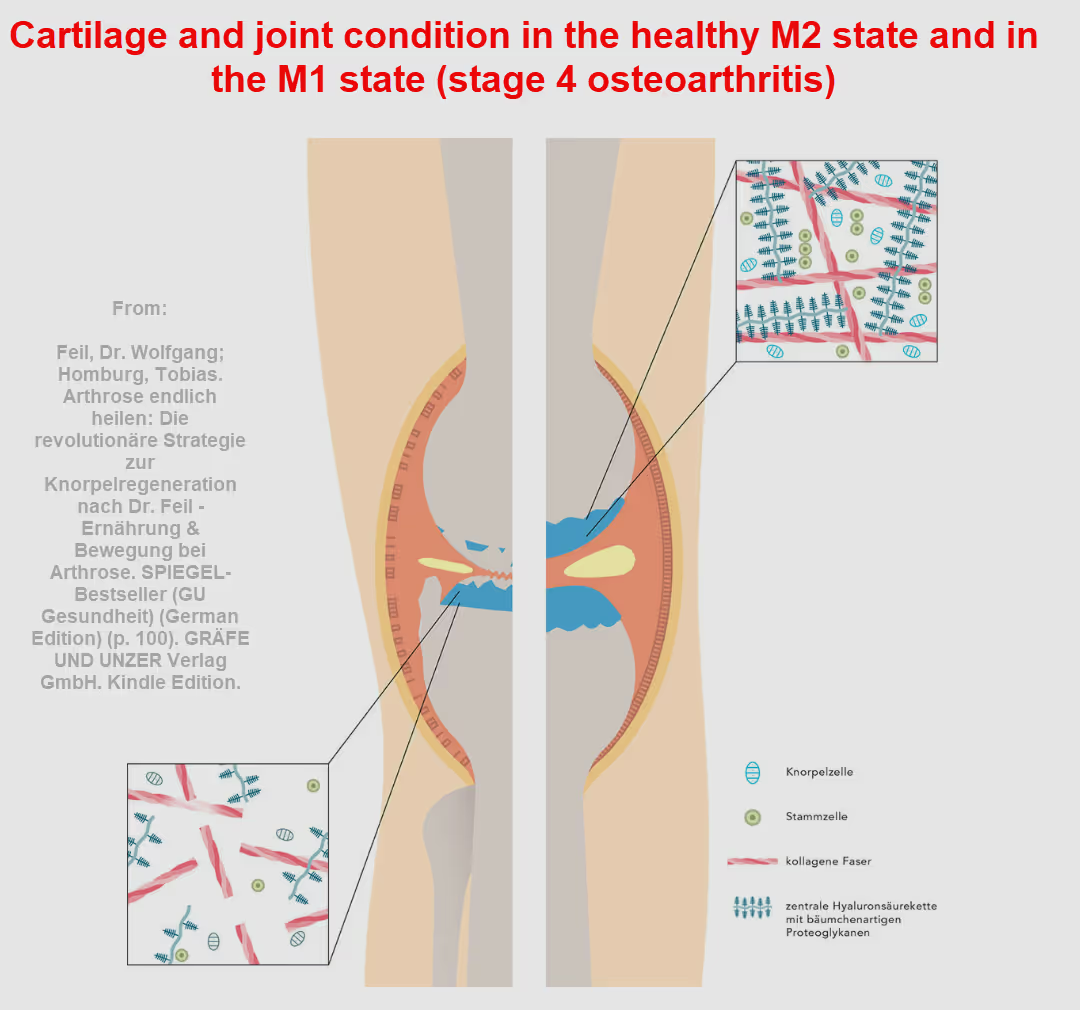
The healing mechanism depends on macrophages — immune cells in the joint — switching into what Feil calls the "M2 healing state." In that state, they release the messenger substances that activate stem cells from the bone marrow to actually build new cartilage. Painkillers suppress the inflammation but simultaneously block this activation.
So the pain goes down. And the self-healing capacity goes down with it. That's why doctors never saw cartilage regenerate in their patients — they were unknowingly preventing it.
What actually switches on the healing process
Feil spent 40 years refining this, starting with professional athletes and working outward. The protocol has several layers — nutrition, specific nutrients, lifestyle, stress management — and they work synergistically. Leave one out and the results drop significantly. He's tested this extensively.
The starting point is anti-inflammatory diet. This won't surprise anyone familiar with the ketogenic lifestyle — the principles overlap considerably. Low sugar, good fats, no inflammatory seed oils. I've covered this framework in depth in my book on the ketogenic lifestyle [link English], [link German]. What Feil adds on top is specific spices, quantified for anti-inflammatory capacity using something he calls the "Frohlox value."
The spice with the highest score? Not turmeric, not ginger. Cloves. Which most people walk past in the spice rack without a second thought.
On top of the diet layer, two groups of nutrients do distinct jobs: one switches the macrophages into healing mode, the other feeds the cartilage cells being recruited from the bone marrow. Both are needed. And vitamin D — something many people are quietly deficient in — turns out to be a non-negotiable switch for the regeneration process. Target blood level: 40–60 micrograms per liter. Most people are nowhere near that.
The timeline is 9 months to stabilize. Not a quick fix. But a real one.
Why this landed differently for me
I've read a lot of health material. As a trained pharmacist with a background in both conventional and integrative health, I'm not easily impressed by "natural healing" claims. What makes Feil credible to me is the specificity of the mechanism. He's not talking about vague wellness — he's describing macrophage polarization, epigenetic gene switching, stem cell activation. The science is there, and he names the studies.
He also worked with elite athletes under conditions where placebo doesn't survive. When world-class handball players need to play pain-free in two days without cortisone, you find out quickly what actually works.
The original interview with the excellent moderator Corina Klein [Link]is in German and you can find it on youtube [Link] (I'll be translating and sharing more of it once I finally get my transcription and TTS workflow sorted — currently in a minor battle with the software). But the content is too good to wait:
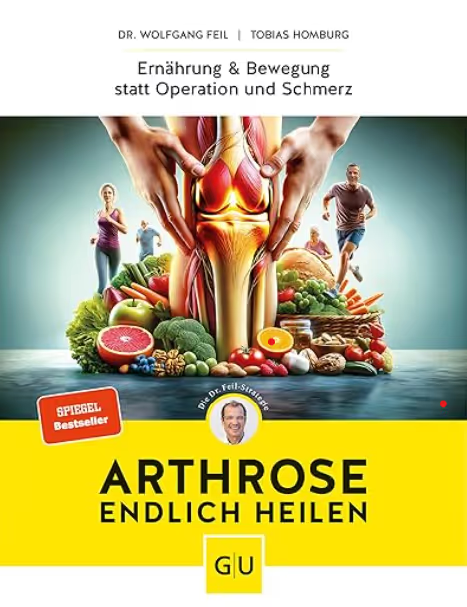
Of course - here is the link to Dr. Feil's latest book, which I read. It is very comprehensive in describing the 4 building blocks of his strategy. (right now, only in German) "Arthrose endlich heilen: Die revolutionäre Strategie zur Knorpelregeneration nach Dr. Feil - Ernährung & Bewegung bei Arthrose". SPIEGEL-Bestseller (GU Gesundheit) von Dr. Wolfgang Feil und Tobias Homburg | 4. Januar 2024 [Link]
Want the full summary?
I put together a structured summary of Dr. Feil's complete protocol — the spice recommendations with practical dosing, the two nutrient groups and what they contain, the lifestyle factors, and the anti-inflammatory diet framework.
Just send me the contact form below with "Dr. Feil summary please" and tell me whether you'd like it in English or German. I'll send it directly.
Richard de Laat is a pharmacist, NLP Trainer, and health advisor based in Switzerland.
v2026-09-24-1836